
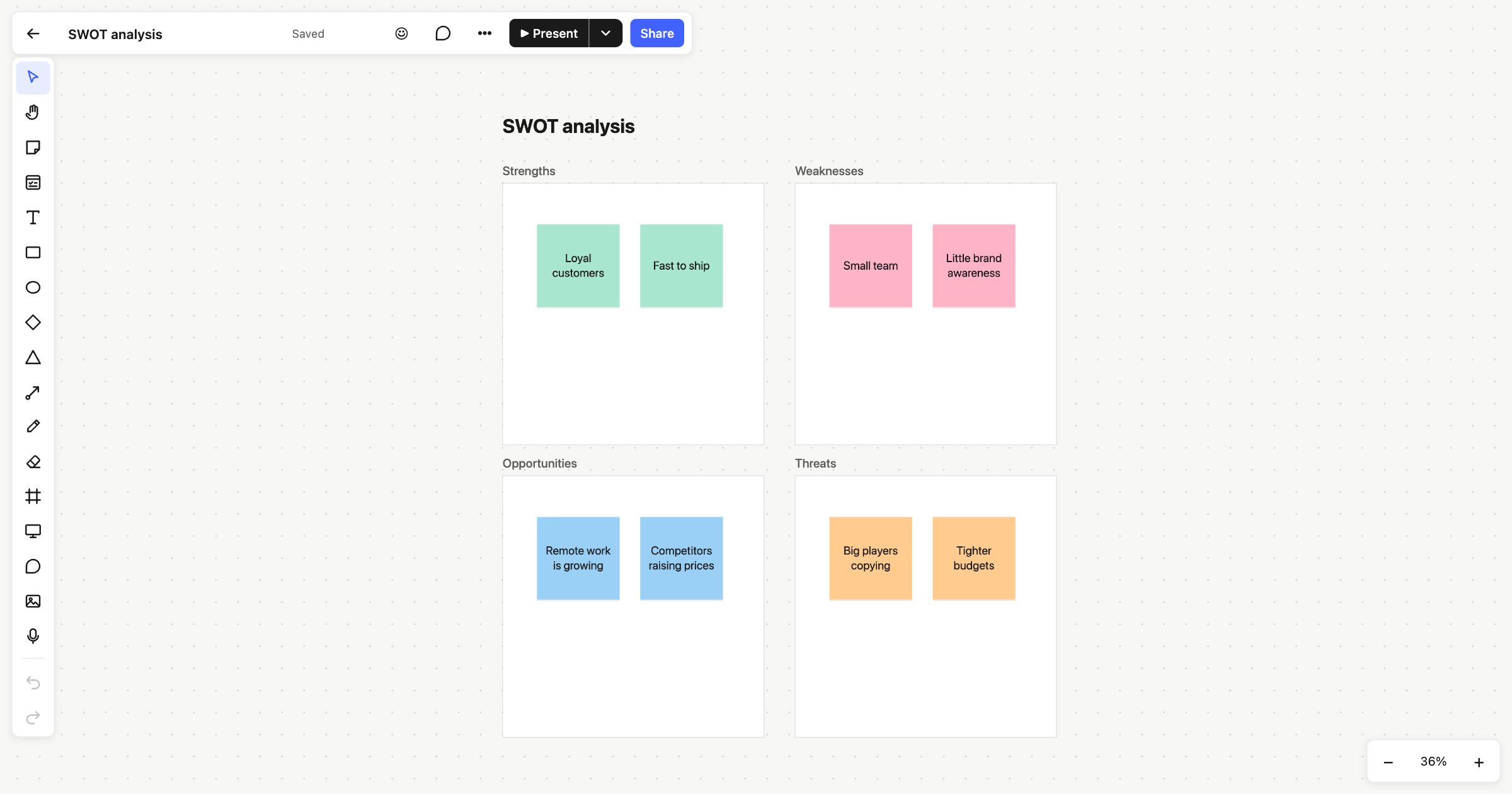
A SWOT analysis looks at a business, product or plan through four lenses: its strengths, weaknesses, opportunities and threats. The first two are about you, and the last two are about the world around you. This SWOT analysis template lays the four out as a two-by-two grid of frames, ready for a team to fill with sticky notes.
When to use a SWOT analysis
Use it before a big decision: a strategy review, a new market, a product launch, or annual planning. It’s also a useful way to size up a competitor, or to take stock of your own career. A SWOT is a starting point rather than a plan. Its value is in getting an honest picture on one page, so the decisions that follow are based on more than a hunch.
How to run it
- Agree the subject (2 minutes). Write down exactly what you’re analysing, and the time frame you have in mind.
- Strengths and weaknesses (10 minutes). Everyone adds notes about what’s true inside the team or business today. Be specific: “Fast to ship” is more useful than “Good team”.
- Opportunities and threats (10 minutes). Now look outward, at customers, competitors, the market and anything else you don’t control.
- Discuss and trim (10–15 minutes). Group duplicates, question vague notes and move anything in the wrong box.
- Pick what matters (5 minutes). Vote on the two or three points in each box that matter most, and turn them into next steps.
What’s on the template
The board is titled “SWOT analysis” and has four frames in a grid:
- Strengths, in green: “Loyal customers” and “Fast to ship”.
- Weaknesses, in pink: “Small team” and “Little brand awareness”.
- Opportunities, in blue: “Remote work is growing” and “Competitors raising prices”.
- Threats, in orange: “Big players copying” and “Tighter budgets”.
Each frame has plenty of room for more notes, and you can resize it if a box fills up. Frames move with what’s inside them, so you can rearrange the grid without losing anything.
Tips
- Write before you talk. Start the shared timer and have everyone write on their own first, so the loudest voice doesn’t set the agenda.
- Use comments for the debate. Pin a comment on a note that needs evidence, and @mention whoever can supply it.
- Share it read-only. Publish the board to give a live link to people outside the workspace. They can open it without an account.
To decide what to do next, take the results to the impact effort matrix or the Eisenhower matrix. For a fuller picture of how a business works, try the business model canvas.
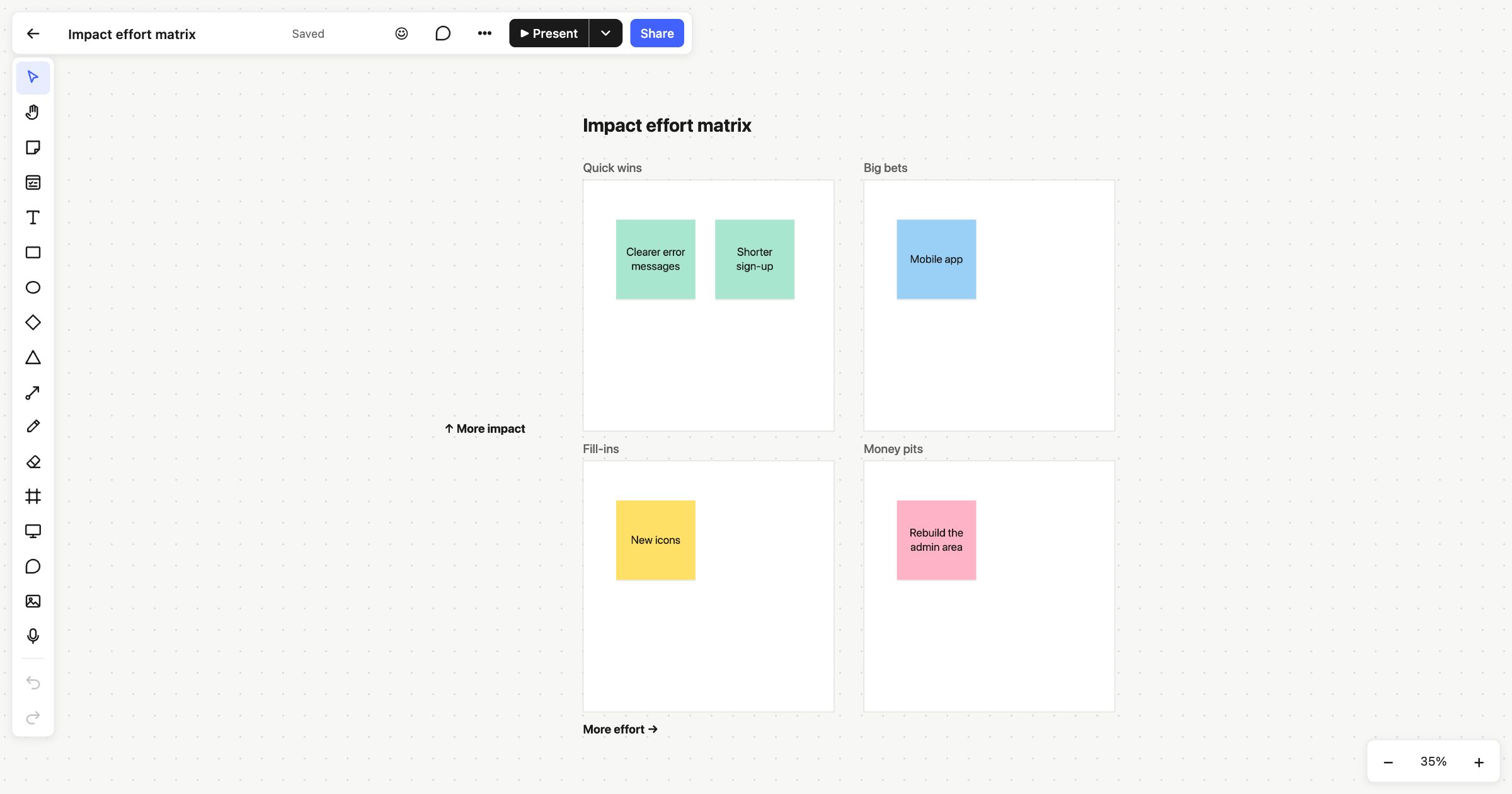 Impact effort matrix
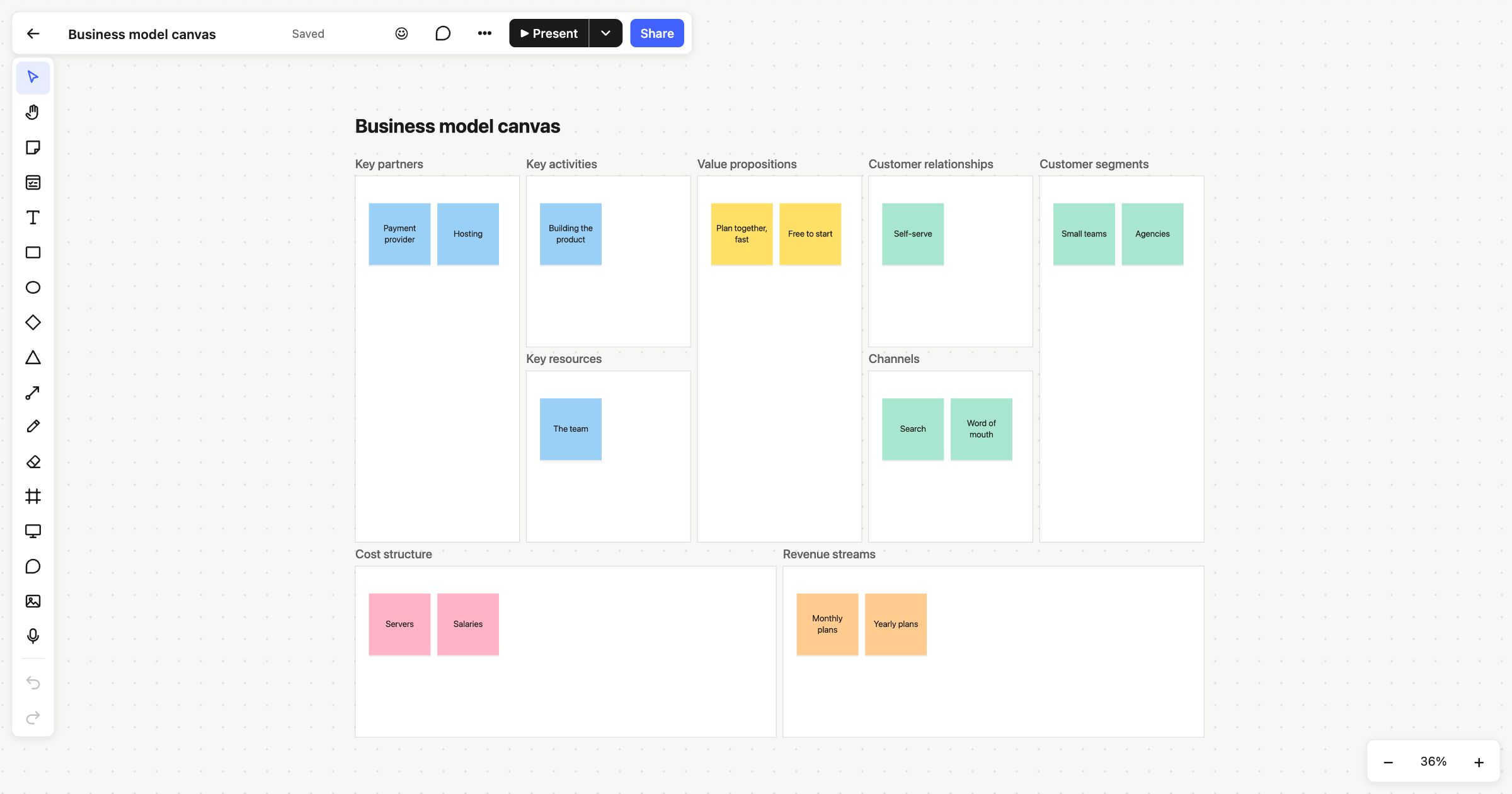 Business model canvas
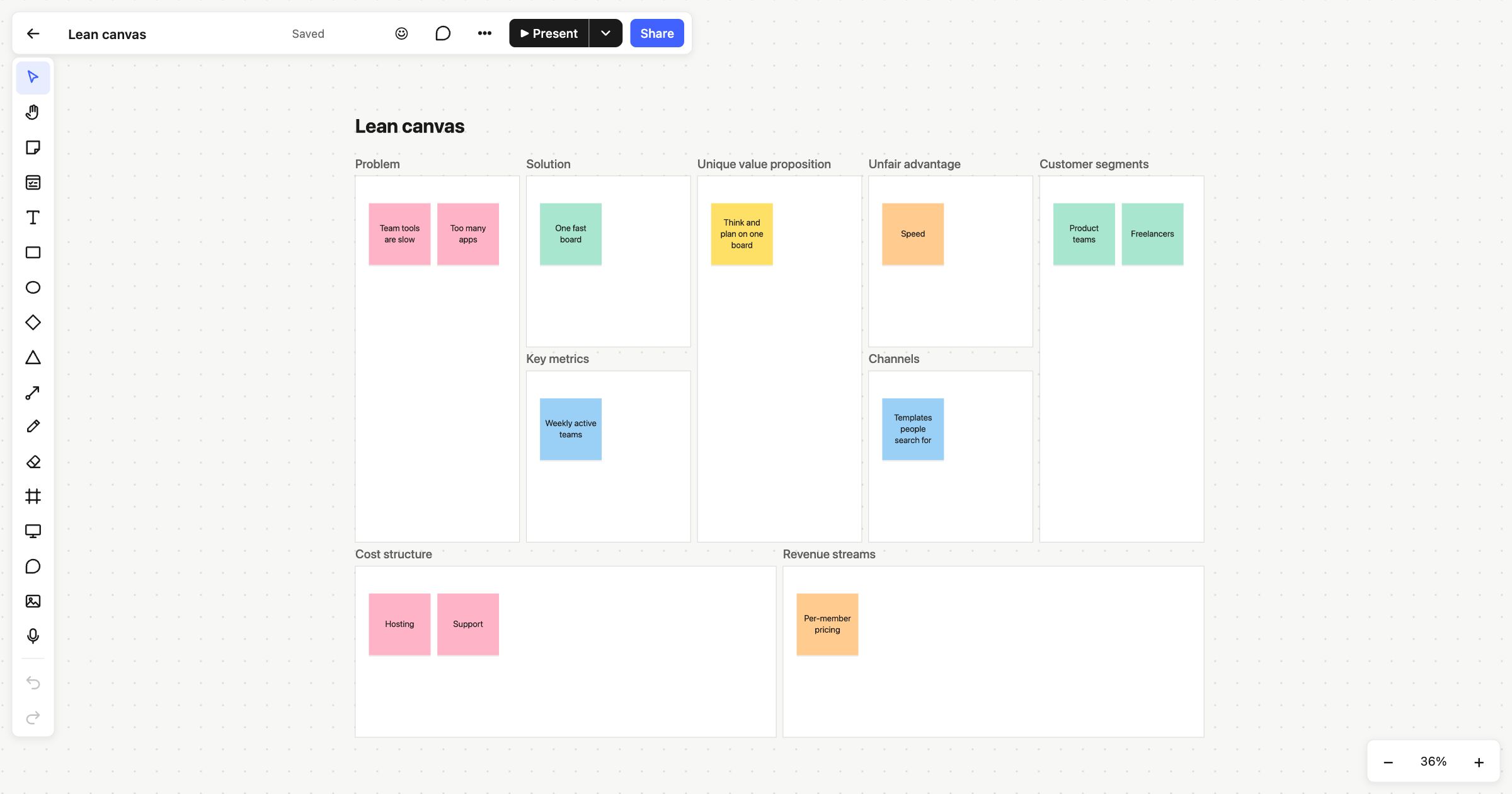 Lean canvas