
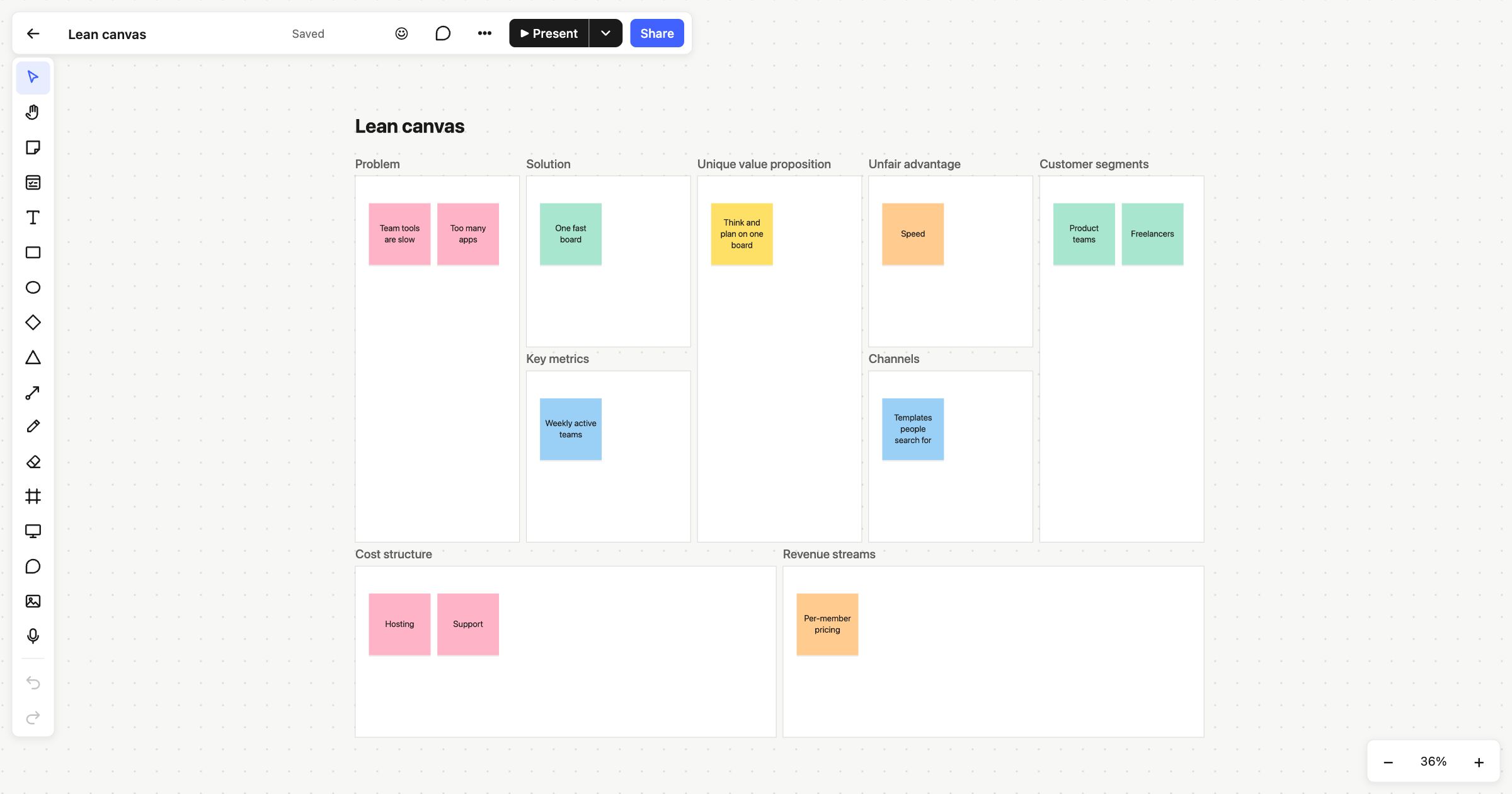
A lean canvas is a one-page plan for a startup idea. It adapts the business model canvas for the early stage, when the hardest questions are whether the problem is real and whether anyone will pay. This lean canvas template puts the problem first, asks how you’ll measure progress and what gives you an edge. It’s for founders, side projects and product teams exploring something new.
When to use a lean canvas
- At the very start of an idea, before you build anything.
- To compare several ideas quickly, one canvas each.
- Before talking to customers, to list the assumptions you need to test.
- When pitching, to check you can explain the whole idea on one page.
How to run it
Give yourself about an hour the first time. Fill in the boxes in this order, with one point per sticky note:
- Problem and customer segments (10 minutes). List the top three problems, and who has them. Note any early adopters.
- Unique value proposition (5 minutes). One clear sentence on why you’re different and worth attention.
- Solution (5 minutes). The simplest thing that addresses each problem.
- Channels (5 minutes). How you’ll reach customers.
- Revenue streams and cost structure (10 minutes). How you’ll charge, and what it costs to run.
- Key metrics (5 minutes). The few numbers that tell you it’s working.
- Unfair advantage (5 minutes). Something that can’t easily be copied or bought. It’s fine to leave this empty at first.
Then go back over the canvas and mark the riskiest assumption. That’s what to test first.
What’s on the template
The board is titled “Lean canvas”. The top section has five columns: Problem, Solution above Key metrics, Unique value proposition, Unfair advantage above Channels, and Customer segments. Beneath them, Cost structure and Revenue streams fill the bottom row.
Each block is a frame with an example sticky note or two, filled in for an imaginary whiteboard product: “Team tools are slow” as a problem, “Weekly active teams” as a key metric and “Speed” as the unfair advantage. Swap them for your own idea.
Tips
- Look back. Every plan includes version history, so you can see how the canvas read before your last round of interviews.
- Test with comments. Pin a comment to each assumption as you test it, and resolve it when you have an answer.
- Get feedback without an account. Publish the canvas as a read-only link, and advisers can open it without signing up.
When the idea firms up, move on to the fuller business model canvas. A SWOT analysis and an empathy map help with the market and the customer.
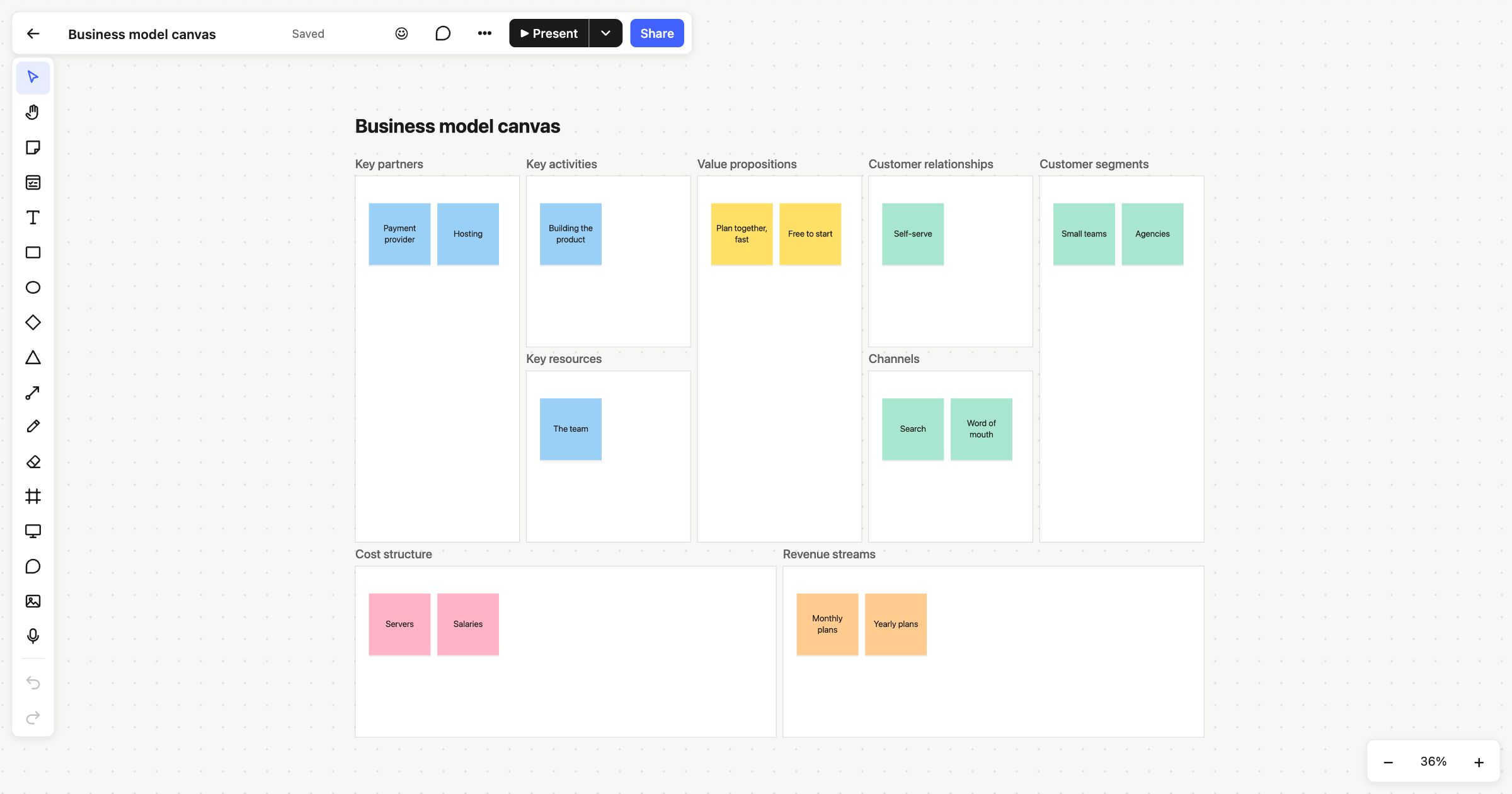 Business model canvas
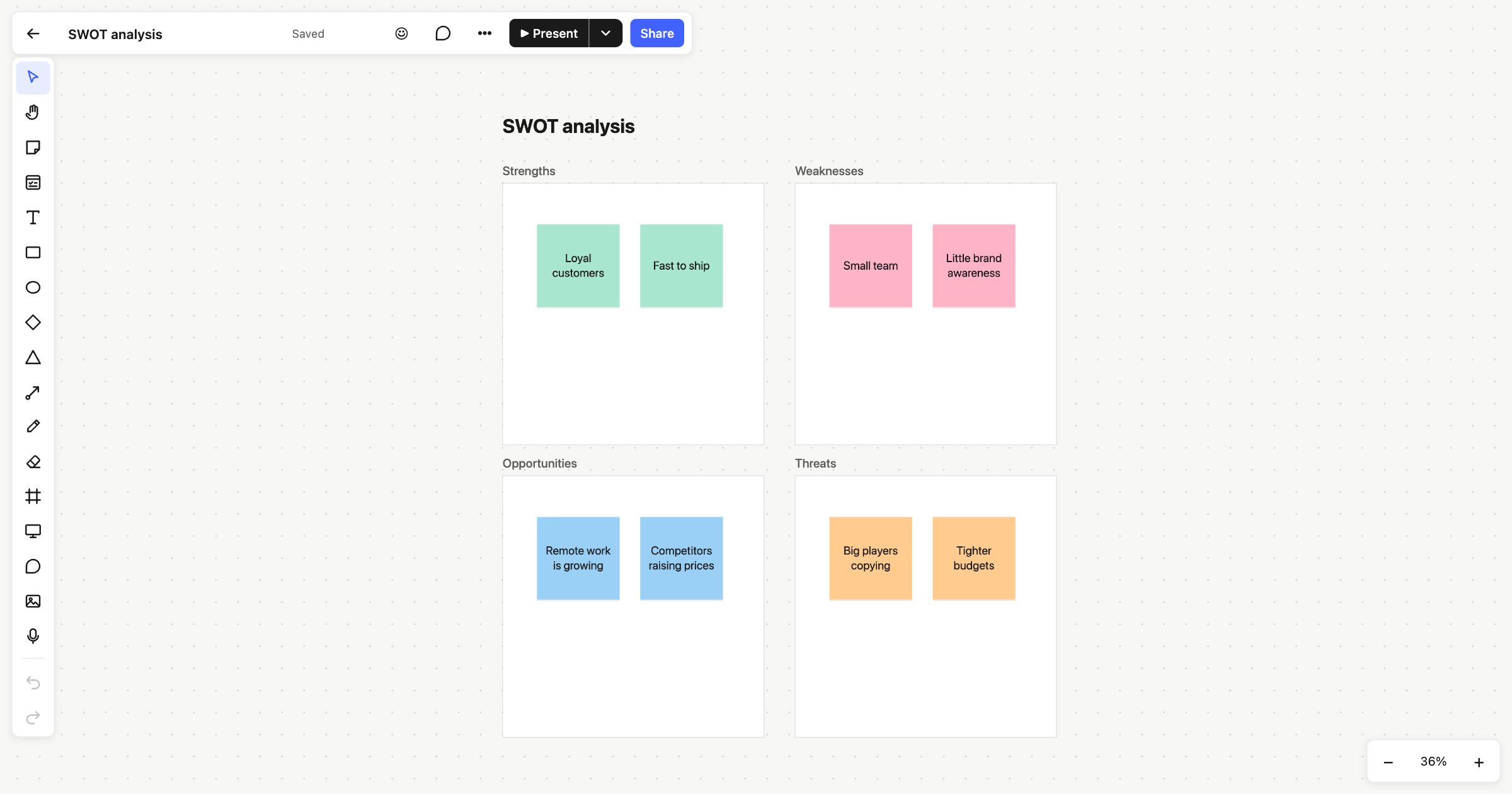 SWOT analysis
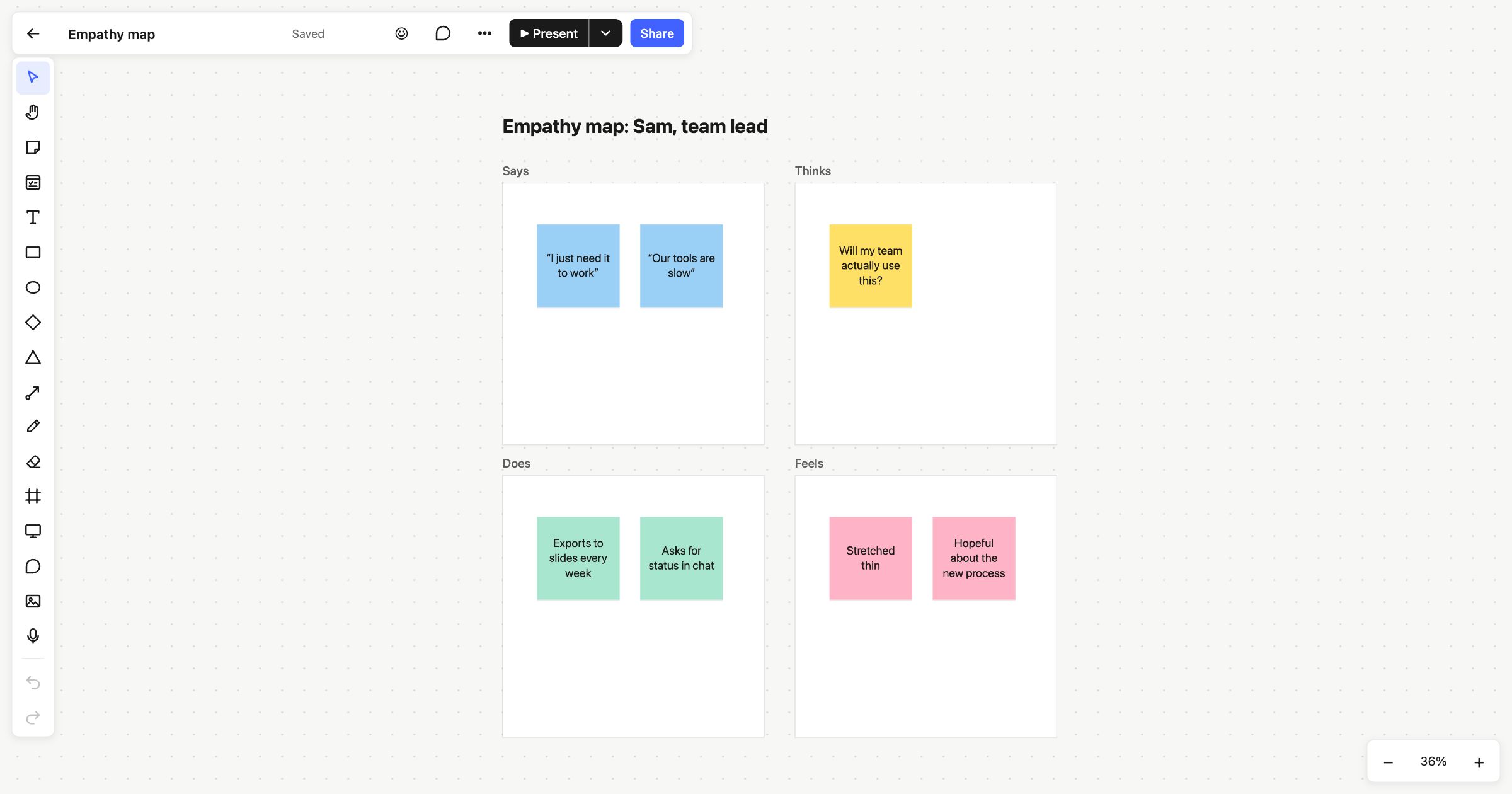 Empathy map